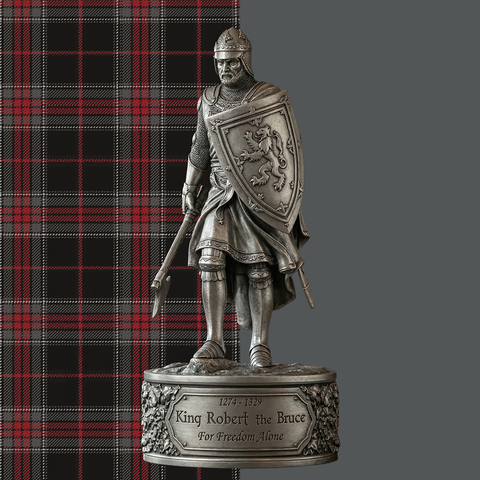
Robert the Bruce: The Architect of Independence
At Bannockburn, Bruce famously split the helmet and skull of the English knight Sir Henry de Bohun with a single blow of his battle-axe.
It was Bruce’s dying wish for his heart to be taken to the Holy Land. It was carried into battle against the Moors in Spain before being returned to Melrose Abbey.
The Fugitive King (1306–1307)
In 1306, Robert the Bruce was a man with a crown but no kingdom. Following the controversial killing of his rival, John Comyn, in a Greyfriars church, Bruce was hurriedly crowned at Scone. However, his reign began in disaster. Defeated by the English at Methven and forced into hiding, he became the "Outlaw King." Excommunicated by the Pope and hunted by Edward I’s forces, Bruce retreated to the rugged shadows of the Western Isles and Rachane Island. It was here, in the darkest winter of his life, that the legend of the spider was born. Watching the tiny creature fail six times to cast its web before succeeding on the seventh, Bruce found the spiritual resolve to "try and try again." He realized that to win Scotland, he could not fight a conventional war; he had to become the shadow in the glen.
The Hammer of the Scots (1307–1313)
Returning to the mainland, Bruce transformed from a traditional nobleman into a master of guerrilla warfare. He understood that the English strength lay in their massive stone fortresses. In a stroke of tactical genius, as he recaptured Scottish castles, he didn't garrison them—he destroyed them. By "slighting" the castles at Forfar, Perth, and even Edinburgh, he ensured the English had no place to hide. This scorched-earth policy forced the English into the open and united the fractured Scottish clans under one banner of defiance. Bit by bit, glen by glen, he dismantled the English administration until only one major stronghold remained: Stirling Castle.
The Field of Bannockburn (1314)
The climax of Bruce’s journey took place in the marshy carse of the Bannock Burn. Facing an English army that outnumbered his own nearly three-to-one, Bruce utilized the terrain as his greatest weapon. He organized his infantry into schiltrons—massive, bristling circles of pikes that acted as "human fortresses." The battle began with a moment of legendary bravado: the English knight Sir Henry de Bohun charged Bruce alone. With a single, calculated strike of his battle-axe, Bruce split de Bohun’s helmet and skull, a feat of strength that electrified his troops. Over two days of grueling combat, the Scottish pikes broke the back of the English heavy cavalry, forcing King Edward II into a humiliating flight and securing a victory that echoed across Europe.
The Declaration and the Legacy (1320–1329)
Bruce’s ultimate victory was not won with the axe, but with the pen. In 1320, the Declaration of Arbroath was sent to the Pope, famously stating: "It is in truth not for glory, nor riches, nor honours that we are fighting, but for freedom — for that alone, which no honest man gives up but with life itself." This document is one of the most important in human history, predating and influencing the American Declaration of Independence. By the time of his death in 1329, Bruce had transitioned from a desperate rebel to the "Good King Robert." He didn't just win a war; he forged the sovereign identity of a nation that refused to be conquered.
Use a video to emphasize your product's unique story, design details or usage instructions.
